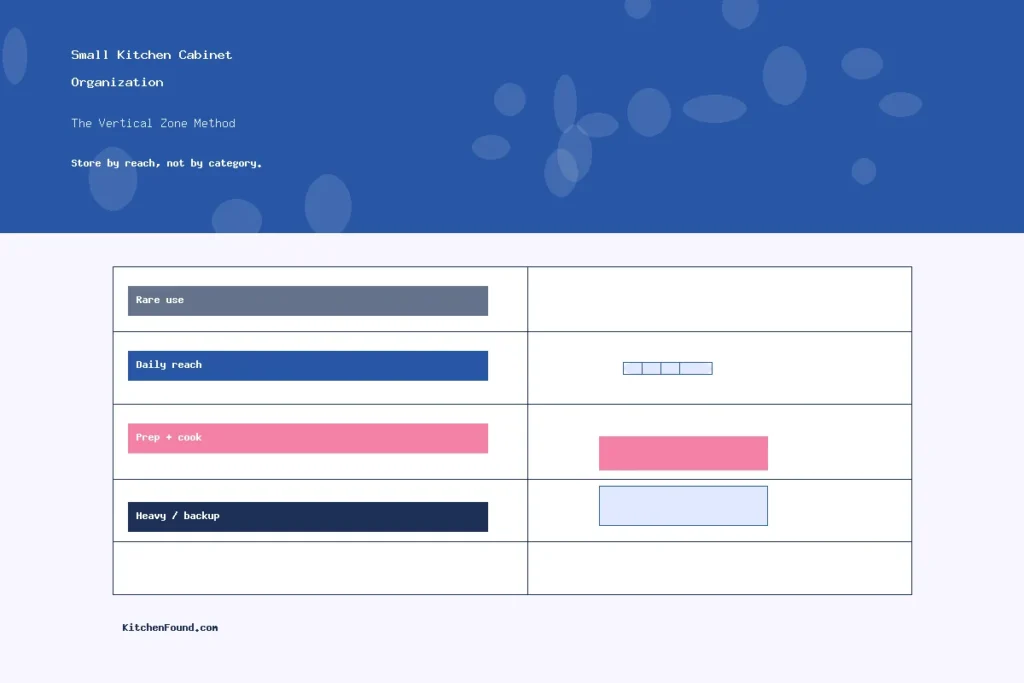
The best cabinet organization system for a small kitchen is to store items by reach height and frequency of use, not by broad category. The Vertical Zone Method turns each cabinet into four practical zones: daily reach, prep-and-cook, lower heavy storage, and rare-use overflow.
If your cabinets look full but still feel hard to use, the problem is usually not laziness or a lack of matching containers. It is a bad return path. You use a pan, move three things to reach it, put it back wherever it fits, and the cabinet slowly becomes a stack of negotiations.
This guide gives you a no-buy cabinet audit, a small-kitchen cabinet map, and a practical zone system you can use before buying shelf risers, drawer dividers, or door organizers.

Why small kitchen cabinets get messy so quickly
Get the free Kitchen Reset Workbook
Use the workbook to map one calmer kitchen system before buying more tools.
Free 18-page workbook. Occasional useful emails. Unsubscribe anytime. Privacy policy.Small cabinets fail when they are organized like a storage catalog instead of a working kitchen. Plates go with plates, food goes with food, appliances go wherever they fit, and the items you touch every day end up behind things you use twice a month.
The fix is not to buy a full set of organizers on the first pass. The fix is to make the cabinet answer one question: how often does this item need to come out, and how easy should it be to put back?
That question matters more in a compact kitchen because one awkward shelf can affect the whole workflow. If your prep board, mixing bowl, oil, and daily pan all live in separate hard-to-reach places, even a simple dinner creates counter clutter fast. Pair this cabinet reset with the small kitchen prep station setup if your counter disappears before cooking starts.
Run this 12-minute no-buy cabinet audit first
Before you add a shelf riser or pull-out bin, empty one cabinet at a time and sort by use. Do not empty every cabinet in the kitchen unless you have time to finish. One completed cabinet is more useful than six half-reset shelves.
- Remove everything from one cabinet. Wipe the shelf, then keep the doors open so you can see the real vertical space.
- Make four piles: daily, weekly, monthly, and almost never. Be honest. The pasta pot you love but use twice a year is not a daily item.
- Measure height, width, and depth. Also check whether the door frame steals space from the front edge.
- Test the return path. Put the most-used item back with one hand. If you have to lift or slide two other objects, that spot is too expensive for daily use.
- Leave a little air. A cabinet packed to the edge looks efficient for one day and becomes frustrating the first time you unload the dishwasher.
The Vertical Zone Method for small kitchen cabinets
The Vertical Zone Method gives every cabinet shelf a job based on reach. You are not trying to make the inside look perfect. You are making the most repeated motions easier.
Zone 1: Daily reach
This is the easiest shelf to reach without stretching, crouching, or moving other items. It should hold the things you use most often: everyday plates, bowls, mugs, the daily pan, or the prep tools that start most meals.
Keep this zone boring. If an item comes out almost every day, it earns the easiest shelf. If it is pretty but rarely used, it does not.
Zone 2: Prep-and-cook support
This zone sits near the daily shelf but can require one extra motion. Use it for mixing bowls, measuring cups, sheet pans, lids, oils, or the tools that support cooking but do not need front-row space every day.
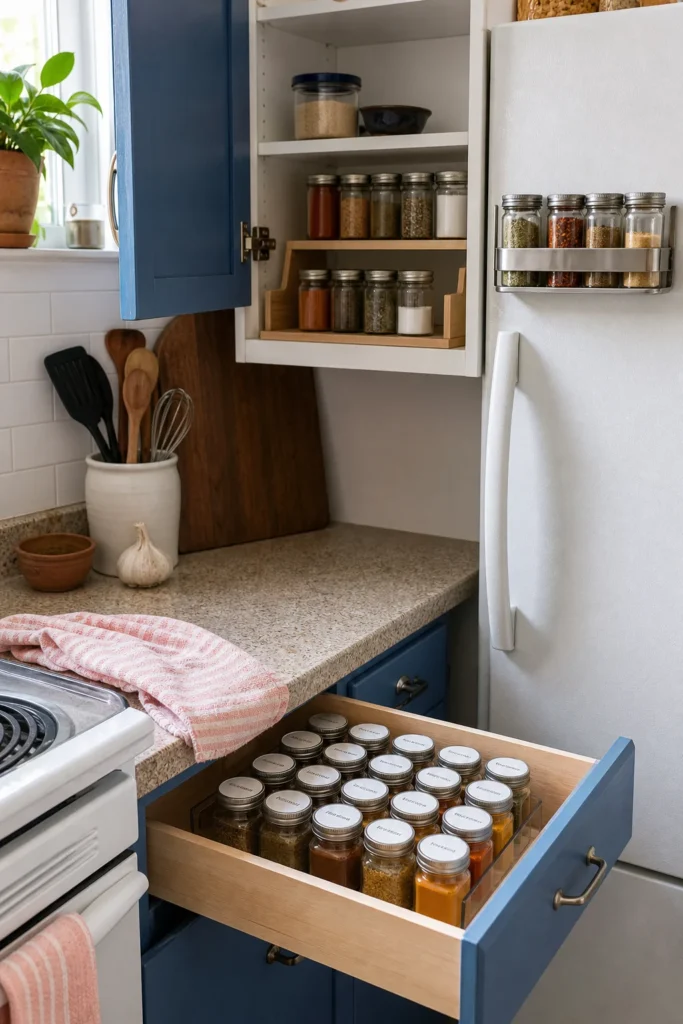
If your cabinets sit near the stove, keep heat-sensitive items away from direct heat and steam. Spices deserve special care; use the small-kitchen spice organization guide if jars are taking over a drawer, cabinet, or counter.
Zone 3: Lower heavy storage
Lower shelves should hold heavier or bulkier items that are awkward overhead: Dutch ovens, stacks of mixing bowls, larger pans, small appliances, or backup ingredients. The point is not only safety; it is repeatability. Heavy items stored low are easier to return correctly.
If a heavy item is used daily, give it a low front position. If it is rare-use, move it lower and farther back so it does not interrupt the daily cabinet.
Zone 4: Rare-use overflow
The top shelf is not a shame shelf. It just has a different job. Use it for occasional entertaining pieces, seasonal baking tools, extra jars, or appliances you want to keep but do not want negotiating with daily.
Keep this zone labeled or visually grouped. Rare-use storage fails when it becomes a mystery shelf. A simple bin for “baking extras” or “party pieces” is enough.
Small kitchen cabinet layouts that usually work
Use these layouts as starting points. The right map depends on where the cabinet sits in relation to the sink, stove, prep counter, and dishwasher.
Dish cabinet near the dishwasher
Put everyday plates and bowls on the easiest shelf. Keep mugs together only if they are used daily; otherwise move the extras up. If you own more dishes than one normal week requires, store the overflow higher instead of making every unloading cycle harder.
Prep cabinet near the counter
This cabinet should support the first five minutes of cooking. A cutting board, mixing bowl, measuring tools, and one everyday oil or seasoning group can live here if they do not crowd the prep surface itself. For a tighter workflow, connect this map to the four-station weeknight kitchen system.
Pantry-adjacent cabinet
Use front visibility for open items and weekly staples. Backstock belongs higher, lower, or behind a clear “refill” boundary. If you keep buying duplicates, start with the pantry inventory checklist before adding more containers.
Awkward corner cabinet
Do not give an awkward corner your daily items unless it has a clean pull-out path. Corners are better for grouped occasional tools, backup supplies, or lightweight bins you can remove fully. If the item cannot come out without a small excavation, it does not belong there.
What to buy only after the cabinet map is clear
These tools can help, but only after you know the exact friction. Do not buy an organizer because the cabinet is annoying. Buy one because a specific shelf, stack, or return path is failing.
Shelf Riser
Best for: Small cabinets and rental kitchens
Using vertical cabinet space before adding more containers
Editorial slot prepared. Recommendation link pending affiliate approval.
Drawer Dividers
Best for: ADHD-friendly kitchen zones
Giving frequently used tools a clear return path in a small drawer
Editorial slot prepared. Recommendation link pending affiliate approval.
Removable Hooks
Best for: Renter-safe storage
Adding an accessible return path for light tools without drilling
Editorial slot prepared. Recommendation link pending affiliate approval.
| Tool | Best for | Price | Link |
|---|---|---|---|
| Shelf Riser | Small cabinets and rental kitchens | Pending approval | Not linked yet |
| Drawer Dividers | ADHD-friendly kitchen zones | Pending approval | Not linked yet |
| Removable Hooks | Renter-safe storage | Pending approval | Not linked yet |
Quick cabinet decision table
| Problem | Try first | Possible tool later |
|---|---|---|
| Items disappear behind other items | Move daily items to the front third | Shelf riser or shallow bin |
| Pans or lids fall over | Reduce the stack and store by frequency | Divider or vertical file-style holder |
| Dish unloading takes too long | Move daily dishes near the dishwasher path | Shelf riser for one extra layer |
| Upper shelves are mystery storage | Group rare-use items into labeled zones | Lightweight open bin |
| Cabinet doors have unused space | Test clearance with the door closed | Removable hook or door organizer |
A 15-minute cabinet reset you can repeat
- Choose the most annoying cabinet, not the largest one.
- Remove only the items from that cabinet.
- Put daily items on the easiest shelf.
- Move heavy items lower and rare-use items higher.
- Return one item at a time and check whether it can come out cleanly.
- Leave one hand-width of empty space near the front if the cabinet is used daily.
- Write one “later” note instead of buying three organizers immediately.
If the cabinet problem is really a rental problem, use the renter-safe kitchen hacks guide for no-drill storage ideas that protect the deposit. If the problem is cleaning supplies under the sink, use the under-sink four-zone reset instead of treating that area like a normal cabinet.
FAQ
What is the best way to organize cabinets in a small kitchen?
The best way is to organize by reach and frequency of use. Keep daily items on the easiest shelf, cooking support items nearby, heavier items lower, and rare-use items higher or farther back.
Should I use bins inside kitchen cabinets?
Use bins only when they make a group easier to remove or reset. A bin helps with backstock, baking extras, or awkward corner storage. It can make daily items worse if it adds another step every time you cook.
How do I organize deep kitchen cabinets?
Put daily items in the front third and use the back for rare-use or backup items. If you need the back every day, use a removable tray or pull-forward bin so the whole group comes out at once.
What should go on the highest cabinet shelf?
The highest shelf should hold lightweight rare-use items: seasonal pieces, occasional baking tools, extra mugs, or entertaining items. Avoid storing daily items there unless the cabinet is unusually easy to reach.
Build one cabinet that resets itself
A small kitchen becomes easier when the most repeated motions stop fighting you. Start with one cabinet, give every shelf a job, and let the daily items earn the easiest space. Once one cabinet has a clean return path, the next one is much easier to fix.
For a wider reset, get the free Kitchen Reset Starter System and use it to map your prep surface, cabinet friction, and weekly kitchen rhythm before buying more storage.
Optional tools referenced in this system
Shelf Riser
Best for: Small cabinets and rental kitchens
Using vertical cabinet space before adding more containers
Editorial slot prepared. Recommendation link pending affiliate approval.
Drawer Dividers
Best for: ADHD-friendly kitchen zones
Giving frequently used tools a clear return path in a small drawer
Editorial slot prepared. Recommendation link pending affiliate approval.
Removable Hooks
Best for: Renter-safe storage
Adding an accessible return path for light tools without drilling
Editorial slot prepared. Recommendation link pending affiliate approval.