The best small kitchen tools are not the ones with the cleverest product page. They are the tools that remove a real point of friction, fit the storage you actually have, and return easily after use. In a compact kitchen, every object competes with prep space, visibility, and retrieval.
This guide is a tool audit, not a shopping list. Use it before buying another organizer or gadget. The goal is to keep fewer things, choose better roles, and make everyday cooking easier.
A tool earns space only when it solves a repeated workflow problem better than the item already doing that job.
Why small kitchens need stricter buying rules
Get the free Kitchen Reset Workbook
Use the workbook to map one calmer kitchen system before buying more tools.
Free 18-page workbook. Occasional useful emails. Unsubscribe anytime. Privacy policy.In a large kitchen, an underused appliance can disappear into a cabinet. In a rental galley kitchen, it may occupy the only shelf that fits mixing bowls or the only outlet near prep. The cost is not only square footage. It is extra decisions every time you cook.
Before buying, ask three questions:
Which recurring bottleneck does this solve?
Where will it live between uses?
Can you put it away in one easy move?
If you cannot answer all three, pause. A product can be attractive and still make the kitchen harder to operate.
7 small kitchen tools that can earn their space
These categories are intentionally ordinary. None of them belongs in every kitchen. Each one has a clear tool slot: a job, a storage home, and a reason to exist.
Best for: reducing guesswork at the stove
Problem it solves: Repeatedly cutting into food, overcooking dinner, or relying on visual cues alone.
Why it can earn space: A slim thermometer is small, easy to retrieve, and useful across multiple meals. FoodSafety.gov provides a safe minimum internal temperature chart for cooked foods.
What to avoid: A bulky connected gadget when a simple readable thermometer solves the same problem.
Best for: repeatable portions and baking without extra cups
Problem it solves: Guessing portions, dirtying many measuring cups, or struggling to repeat a recipe.
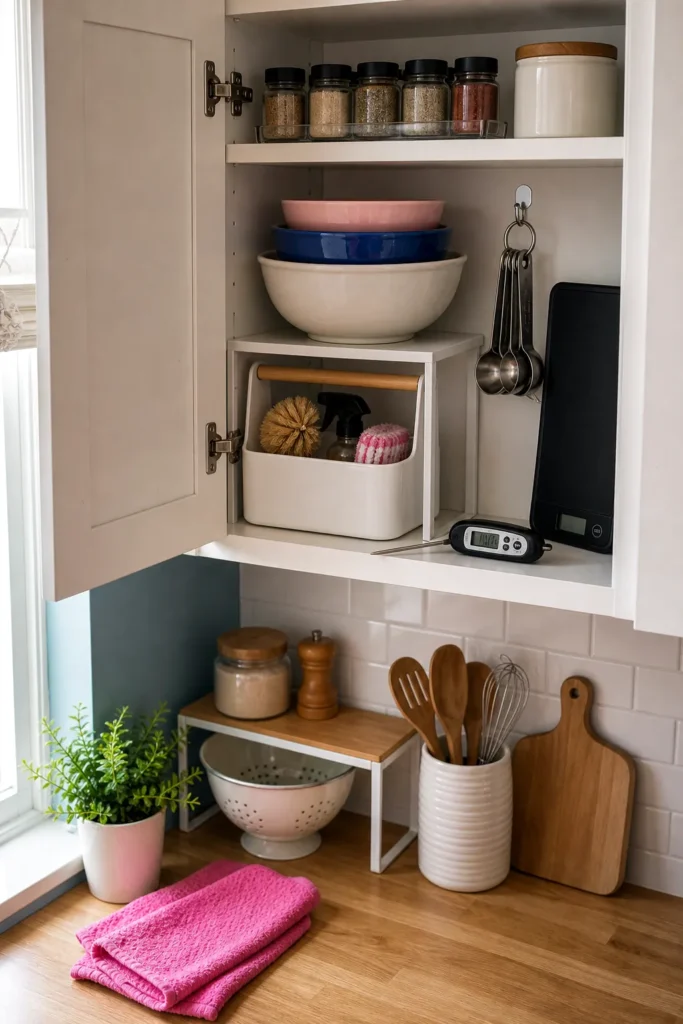
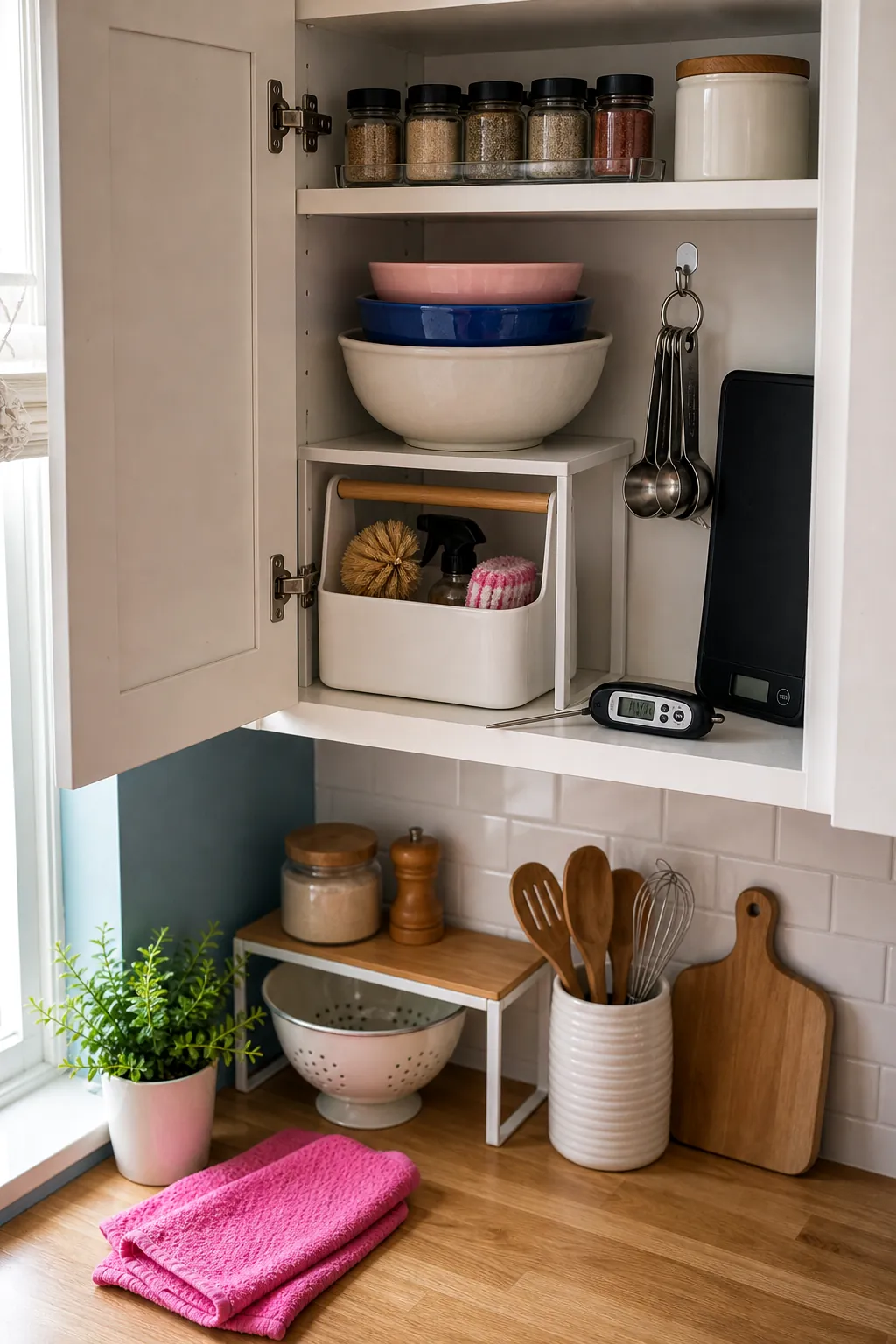
Why it can earn space: A flat scale stores vertically beside a cutting board or tray. It can replace several small measuring tasks without dominating the counter.
What to avoid: An oversized model that cannot store upright or wipe clean easily.
Best for: prep without cabinet sprawl
Problem it solves: Bowls that occupy an entire shelf while still being hard to retrieve.
Why they can earn space: A restrained set nests into one footprint. Choose sizes you actually use.
What to avoid: Large sets with specialty sizes that become cabinet filler.
Best for: visible cabinet retrieval
Problem it solves: Stacked dishes, pantry jars, or mugs that require lifting three things to reach one.
Why it can earn space: A freestanding riser creates a second retrieval level without drilling and can move with a renter.
What to avoid: Filling the new level simply because it exists. Use it to reduce moves, not increase inventory.
Best for: frequently used lightweight tools
Problem it solves: Measuring spoons, towels, or small tools disappear into a crowded drawer.
Why it can earn space: A carefully placed removable hook can move a lightweight tool closer to its workflow. Follow the manufacturer’s surface and weight instructions, and use the renter-safe planning in the renter-safe kitchen hacks guide.
What to avoid: Hanging everything in sight or exceeding weight limits.
Best for: faster resets
Problem it solves: Cleaning supplies spread behind plumbing and require a cabinet excavation.
Why it can earn space: One handled caddy keeps the weekly reset kit portable and protects pipe access. Use the 4-zone under-sink organization system before purchasing.
What to avoid: A rigid organizer that ignores valves, pipes, or moisture risk.
Best for: reducing food waste and forgotten leftovers
Problem it solves: Open food disappears behind newer groceries.
Why it can earn space: One shallow open bin gives short-life foods a visible home. It is a decision zone, not a full fridge makeover.
What to avoid: Buying a full matching container system before trying the 15-minute fridge reset.
| Tool | Best for | Price | Link |
|---|---|---|---|
| Digital Food Thermometer | Food-safety checks | Pending approval | Not linked yet |
| Compact Digital Scale | Small prep zones | Pending approval | Not linked yet |
| Nesting Mixing Bowls | Compact prep stations | Pending approval | Not linked yet |
| Shelf Riser | Small cabinets and rental kitchens | Pending approval | Not linked yet |
| Removable Hooks | Renter-safe storage | Pending approval | Not linked yet |
| Compact Under-Sink Caddy | Under-sink reset zones | Pending approval | Not linked yet |
| Shallow Use-First Bin | Fridge visibility resets | Pending approval | Not linked yet |
Run a 10-minute tool audit before buying
- Name the friction. Write one sentence: “Cooking feels harder because…”
- Find the current workaround. Notice what you move, stack, search for, or avoid.
- Measure the tool slot. Record cabinet width, shelf height, counter depth, or drawer clearance.
- Test a no-buy version. Use a tray, box, existing bowl, or temporary label for one week.
- Buy only if the problem repeats. The purchase should improve the workflow, not only the photograph.
This is especially important in hidden storage. Before buying cabinet organizers, use the under-sink reset and the pantry inventory checklist to discover what the space actually needs.
What not to buy first
A matching container set for every shelf
Start with visibility and measurement. A pantry or fridge can look coordinated and still hide food behind containers that are too deep, too tall, or annoying to wash.
A single-purpose appliance for a hypothetical habit
Buy for routines you already perform, not for a version of yourself you hope will appear after delivery. If an appliance performs one job, ask how often that job occurs and where the appliance will live.
An organizer that blocks retrieval
A cabinet bin is not useful if you need to unload it to reach the item behind it. Small kitchens benefit from clear front-to-back logic and fewer moves.
A tool that creates a cleaning burden
Extra parts, narrow crevices, and awkward shapes add maintenance. The tool should save more effort than it creates.
Build a tool hierarchy for your real kitchen
Not every useful tool deserves the easiest shelf. Sort equipment by frequency and workflow role.
- Daily reach: Knife, cutting board, kettle or coffee setup, frequently used pan, dish towel.
- Weekly reach: Mixing bowls, scale, sheet pan, colander, reset caddy.
- Occasional reach: Specialty bakeware, entertaining pieces, seasonal tools.
- Exit candidates: Duplicates, broken items, gadgets that have not solved a real problem.
If your surfaces still collect tools after this audit, use the small kitchen prep station setup to define what can remain near prep and what must return to storage.
Use affiliate links without turning the kitchen into a catalog
KitchenFound may earn a commission when readers buy through affiliate links, at no extra cost to the reader. That does not change the rule: recommend a tool because it fits a workflow role, not because a product category is easy to monetize.
When you compare products, look for measurements, weight limits, care instructions, replacement parts, and the return path. For cleaning products, the EPA’s Safer Choice product search can help identify products that meet its program criteria.
Frequently asked questions
What is the first tool to buy for a small kitchen?
Start with the repeated bottleneck, not a universal list. If prep space is the issue, protect a cutting-board-sized surface. If food disappears, designate a use-first fridge bin. If you guess doneness, consider a readable food thermometer.
Are magnetic tools renter-safe?
They can be when attached to a suitable magnetic surface and used within their instructions. Do not assume every appliance surface is appropriate, and do not hang heavy objects where they could fall into a cooking path.
Should I buy organizers before decluttering?
No. Remove duplicates, measure the space, and observe retrieval problems first. Organizers should support a defined system.
How many kitchen gadgets should I keep?
There is no perfect number. Keep the tools that solve recurring problems, fit their homes, and return easily after use. Let square footage and workflow decide.
How do I keep the counter from filling up again?
Define a protected prep station and run the 30-minute Sunday kitchen reset routine. Counters stay clearer when each tool has a return path.
Choose one tool slot, not a shopping spree
A calmer kitchen rarely begins with more products. It begins with a clearer problem. Use this audit to identify one recurring point of friction. Test a no-buy version. Measure the slot. Then choose the smallest tool that genuinely improves the system.